
AI UGC Personalization: Best Practices for Brands
AI-powered UGC personalization is essential for brands to scale authentic engagement, increase conversions, and boost revenue.
AI-powered UGC personalization is essential for brands to scale authentic engagement, increase conversions, and boost revenue.
4.98 /5 - from 58k reviews
Trusted by 50,000+ creators — get real engagement delivered to your profile in minutes, not days.

AI is transforming how brands use user-generated content (UGC) by delivering tailored experiences. Instead of manually sorting through endless posts, AI tools like recommendation engines, sentiment analysis, and computer vision help brands surface the right content for the right audience. This approach boosts engagement, trust, and conversion rates by aligning UGC with individual preferences. Here’s what you need to know:
AI-powered UGC personalization helps brands scale content efficiently while keeping it relevant and engaging for their audience.
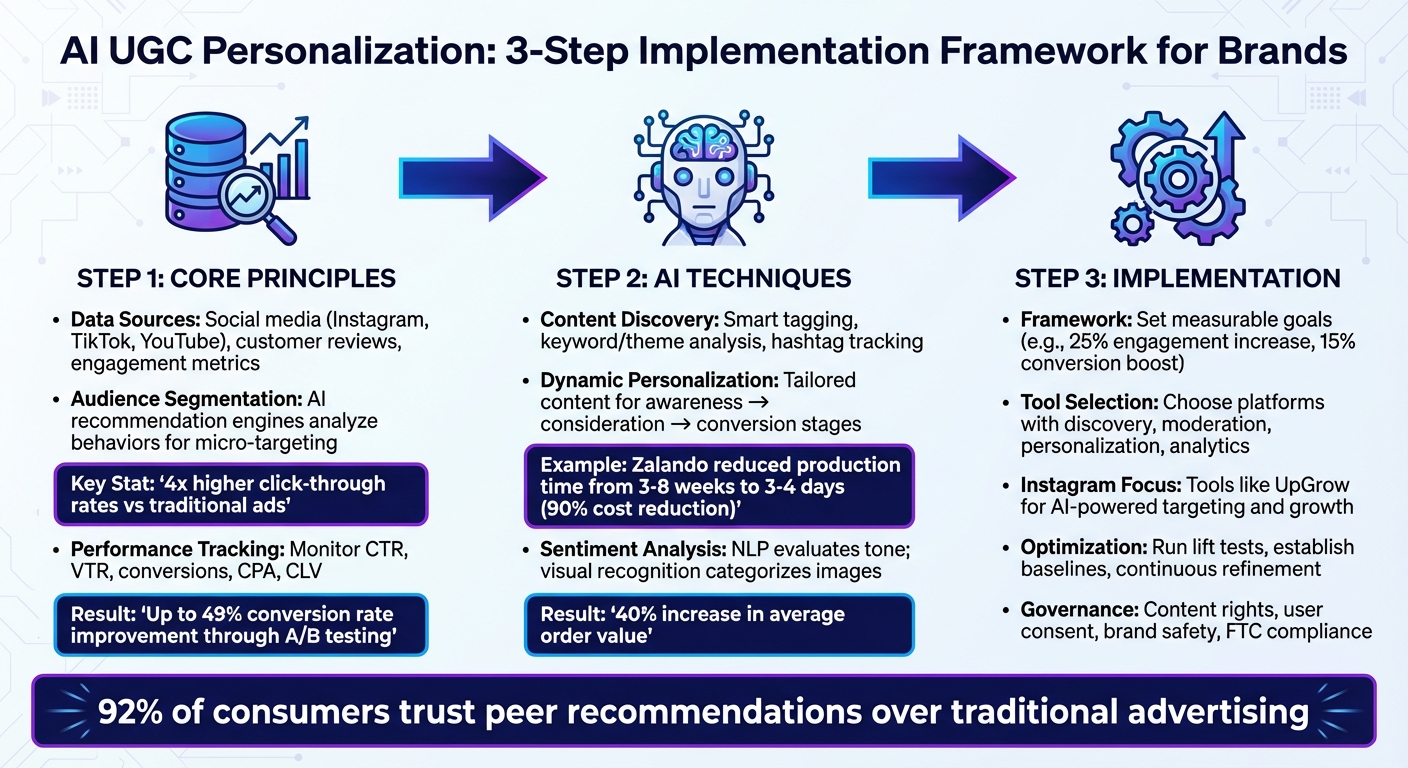
AI UGC Personalization Implementation Framework: 3-Step Process for Brands
To make user-generated content (UGC) truly impactful, personalization must focus on three key areas: collecting relevant data, targeting specific audience groups, and evaluating performance regularly. These principles help ensure that your efforts lead to meaningful business outcomes rather than unnecessary complexity.
A variety of UGC data sources can help align content with audience preferences. Social media platforms like Instagram, TikTok, and YouTube provide a wealth of material, including posts, Stories, Reels, and tutorials. Beyond visuals, customer reviews and testimonials offer authentic insights into common challenges and desires that resonate with specific groups.
Engagement metrics - such as likes, comments, shares, and even scrolling behavior - reveal what grabs attention. Demographic details further refine how content aligns with audience personas, while sentiment analysis categorizes feedback into positive, negative, or neutral, enabling brands to respond appropriately. This matters because 92% of consumers trust recommendations from peers more than traditional advertising.
Tracking product-specific mentions also helps AI tools surface relevant testimonials for specific items. To make this process efficient, brands can create a searchable content library using automated tagging, organizing assets by themes, keywords, or emotional tone. These data inputs lay the groundwork for precise audience targeting.
AI recommendation engines take personalization to the next level by analyzing individual behaviors to deliver content tailored to specific interests. Instead of showing the same UGC to everyone, brands can create micro-segments based on engagement patterns, purchase history, or browsing habits. For instance, someone engaging with workout content might see exercise-related UGC, while a nutrition-focused audience might receive meal prep testimonials.
This approach delivers impressive results: UGC campaigns often achieve four times higher click-through rates and significantly lower cost-per-click compared to traditional ads. Tools like UpGrow enhance targeting on platforms like Instagram by using AI filters based on location, age, gender, and language. Additionally, real-time analytics provide insights into which audience segments generate the most valuable UGC.
AI also enables lookalike targeting, identifying users similar to a brand’s best customers. Companies excelling in personalization report 40% higher revenue from these efforts compared to competitors. By delivering authentic peer recommendations to the right audience at the right moment, brands can maximize their impact. However, measuring performance is crucial to maintaining and improving results.
Tracking performance metrics ensures that personalization efforts are effective. Start by monitoring engagement indicators like click-through rates (CTR), view-through rates (VTR), and shares to measure interest. To assess business impact, keep an eye on conversion rates, cost-per-acquisition (CPA), customer lifetime value (CLV), and overall revenue.
A/B testing various UGC formats, scripts, and calls-to-action can lead to conversion rate improvements of up to 49%. AI systems learn from this data, refining their recommendations over time. For example, if a specific style of UGC performs well with a certain audience segment, the algorithm will prioritize similar content. Testing content variations within a 48–72 hour window before scaling successful formats and using UTM parameters to track leads and sales accurately can further optimize campaigns.
Refining user-generated content (UGC) strategies with AI goes beyond basic personalization - it's about leveraging advanced tools to make content more relevant, timely, and impactful.
AI is revolutionizing how brands discover and organize UGC. Instead of manually sifting through endless posts, AI-powered tools streamline the process by identifying high-performing, brand-safe content across social platforms. These tools use smart tagging and categorization to analyze media based on keywords, themes, or even emotions, making it easier to find the right content for specific campaigns. As Social Native explains, AI tools can even uncover the emotional context behind customer content, providing deeper insights into what resonates with audiences.
Machine learning also tracks trending hashtags and emerging themes, ensuring brands stay relevant. However, authenticity remains key. Consumers increasingly value raw, organic content over overly polished media. As UGC Builder points out, "The brands winning in 2025 are those that use AI to amplify genuine moments rather than create artificial ones". This shift reflects growing skepticism toward content that feels staged or inauthentic.
AI takes personalization to the next level by tailoring UGC to each stage of the customer journey. During the awareness phase, AI identifies trending topics and hashtags to highlight shareable content that increases visibility. In the consideration stage, it analyzes user interactions - like comments, shares, and likes - to recommend testimonials that align with individual preferences. At the conversion stage, AI incorporates real customer visuals into product pages and crafts personalized calls-to-action.
Real-world examples highlight these benefits. European retailer Zalando leveraged generative AI to dramatically cut product image production time from 3–8 weeks to just 3–4 days, reducing costs by nearly 90%. Similarly, edtech brand Headway used AI to optimize ad campaigns, achieving 3.3 billion impressions in just six months and boosting video ad ROI by 40%. These cases show how aligning content with each step of the customer journey can drive engagement and results.
AI also excels at analyzing customer sentiment and visuals to enhance personalization. Natural Language Processing (NLP) evaluates customer reviews to gauge tone and sentiment, helping brands surface content that resonates with specific interests. At the same time, visual recognition technology categorizes images and videos by style, product features, or themes, ensuring alignment with campaign goals.
This approach allows brands to tailor UGC effectively. For instance, one customer might see content emphasizing durability, while another sees testimonials highlighting affordability - all from the same content pool. Brands using AI-driven personalization have reported up to a 40% increase in average order value compared to generic content. Additionally, AI helps filter out inappropriate content, ensuring that curated UGC aligns with brand values and maintains community standards.
Before diving into AI tools, it's critical to lay out a clear plan. Start by defining specific, measurable goals. For instance, aim to increase Instagram engagement by 25%, boost conversion rates on UGC-driven product pages by 15%, or reduce manual curation time by 50%. These benchmarks help guide your AI strategy and provide a way to measure success.
Next, identify your key audiences. Prioritize high-value groups like repeat buyers, cart abandoners, or first-time visitors. Then, map out their preferred channels - whether it's Instagram Stories and Reels, product pages on your website, email campaigns, or paid ads. This ensures you're placing the most relevant UGC at the right stage of their journey, from initial awareness to long-term retention.
Set up clear governance rules to protect your brand. Define how content rights are managed, secure user consent, and establish guidelines for brand safety. Make sure your practices align with U.S. data privacy laws and FTC disclosure requirements, particularly for paid placements. Decide what AI can approve automatically - such as UGC with positive sentiment, high engagement, or clear product visibility - and what requires human review. These steps help ensure consistency and accountability.
Assign responsibilities across your teams. Marketing can handle audience strategies and UGC placements, while social and community teams manage creator relationships and permissions. Data teams should validate AI models and track performance, while legal ensures compliance. Establish workflows where AI handles tasks like discovering and tagging UGC, filtering it for relevance and safety, and predicting performance. This allows your team to focus on final approvals. Regular performance reviews and monthly updates to your AI models will refine its recommendations over time.
With this framework in place, the next step is selecting the right AI tools to bring your strategy to life.
When choosing AI platforms, look for tools that simplify UGC discovery and maintain brand safety. Evaluate platforms based on four key areas: discovery and curation (can it automatically find, tag, and rank UGC by predicted performance?), moderation and safety (can it filter out inappropriate or off-brand content using sentiment analysis tailored to U.S. audiences?), personalization and testing (does it offer features like dynamic creative optimization, audience-specific content rules, and A/B testing?), and analytics and ROI (can it track clicks, conversions, and revenue in USD back to individual UGC assets?).
For brands heavily focused on Instagram, platforms like UpGrow can be a game-changer. UpGrow combines AI with human expertise to grow real followers - no bots or fake accounts. It optimizes profiles through precise targeting based on location, age, gender, and language. Its AI-powered engine enhances audience insights and reach, which are essential for UGC personalization. With tools like a viral content library, the Boost™ growth accelerator, and 24/7 monitoring, UpGrow is ideal for quickly scaling Instagram-focused UGC strategies. Its real-time analytics dashboard lets teams track which posts, Stories, or Reels are driving engagement and follower growth.
Make sure your chosen tools integrate seamlessly with your existing systems, such as social platforms, web analytics, ad platforms, and CRM tools. Also, verify that all integrations comply with platform policies - like Instagram's API rules - and privacy regulations.
Once your framework and tools are in place, focus on tracking results to refine your strategy. Measure incrementality by running lift tests: show one audience segment AI-personalized UGC and another non-personalized content. Monitor engagement metrics like likes, shares, comments, and saves, as well as business outcomes like click-through rates, conversion rates, revenue per session, and cost per acquisition (in USD).
Establish baseline benchmarks - your current UGC performance without AI - and set clear success thresholds, such as achieving a 10–20% increase in revenue from UGC-driven sessions. This will help you evaluate whether personalization adds real value.
Treat AI UGC personalization as an ongoing process. Continuously analyze performance data, such as engagement, clicks, conversions, and sentiment, to retrain and improve AI recommendations. Use these insights to prioritize UGC that historically performs well with similar audiences and phase out underperforming content. Experiment with different UGC angles to uncover what resonates most, then incorporate those patterns into your AI's ranking logic. Schedule regular human reviews to catch potential biases and ensure the algorithm adapts to changing trends, seasonal behaviors, and regional events in the U.S. market.
Throughout this discussion, one thing has become clear: brands need to focus on clear objectives and ongoing refinement to stay ahead. AI-powered personalization of user-generated content (UGC) has become a must-have for brands aiming to remain competitive. Why? Because authenticity is what builds trust and loyalty, and UGC plays a central role in modern marketing strategies. The top-performing brands don’t just see UGC as content - they treat it as invaluable customer feedback that shapes their products and strategies.
Start by defining specific, measurable goals. Whether you’re looking to increase engagement, boost conversions, or drive revenue, having a clear target is essential. Then, incorporate AI-driven personalization to keep your content dynamic and engaging. For Instagram-focused brands, tools like UpGrow demonstrate how blending AI’s precision with human expertise can lead to well-rounded UGC strategies. As Social Native puts it:
"AI for UGC isn't just about automation; it's about adding a smarter, more personalized touch to your brand's content strategy".
Striking the right balance between AI automation and human oversight is key to keeping your content authentic and impactful. These strategies set the stage for the next wave of innovation in UGC personalization.
Looking ahead, personalization is evolving in exciting ways. One major trend is the rise of real-time content activation and stronger connections with creators. Creator marketing is quickly becoming a cornerstone for brand growth. AI is no longer just sorting content; it’s now identifying the best creator-consumer matches. This means brands can collaborate with creators whose audiences genuinely align with their mission and values. Recent advancements like Meta Partnership Ads are making it easier to integrate creator content with advanced AI targeting, unlocking new ways to scale authentic UGC through paid campaigns.
Real-time personalization is another game-changer. AI systems are moving toward instant content discovery and activation, allowing brands to tap into trending sentiment and deploy UGC that resonates with specific audience segments right when it matters most. This kind of responsiveness helps brands connect with customers’ emotions and preferences in real time.
The challenge, however, is maintaining authenticity while scaling these efforts. As AI continues to advance, brands must ensure that automation enhances - rather than diminishes - the raw, genuine feel of user-generated content. Balancing technology with human touch will be critical for success.
AI takes user-generated content (UGC) to the next level by automating content moderation. It quickly identifies and filters out inappropriate material, keeping your platforms safe and user-friendly. Beyond moderation, AI dives into sentiment analysis to gauge audience reactions, categorizes top-performing posts, and curates content that aligns perfectly with your brand’s style and what your audience loves.
What’s more, AI allows brands to personalize UGC on a large scale. It tailors content to speak directly to specific customer groups. Take UpGrow, for instance. They use cutting-edge AI tools to boost Instagram engagement by focusing on organic growth. Their approach includes smart targeting, real-time analytics, and optimizing content for specific audiences. The result? Brands can foster genuine connections with their followers and spark meaningful interactions.
To make AI-powered user-generated content (UGC) personalization work for your brand, start by setting clear marketing objectives. Are you aiming to boost engagement? Strengthen brand loyalty? Knowing your goals will guide your strategy. Next, gather genuine UGC - think photos, reviews, and social media posts - that aligns with these objectives. This content will serve as the foundation for your personalization efforts.
AI tools can then step in to analyze this content. They can help craft visuals, generate text that mirrors the tone of real users, and customize materials for specific audience segments based on factors like age, location, or personal preferences. Once your personalized UGC is ready, deploy it across your platforms and track its performance using analytics. This data will help you fine-tune your strategy to drive better engagement and higher conversions.
For example, platforms like UpGrow simplify this process for Instagram campaigns, helping brands achieve organic growth while fostering authentic connections with their audience.
AI brings a touch of realism to user-generated content (UGC) personalization by diving into actual user-created images, videos, and text. It picks up on natural details like lighting, emotional expressions, and conversational tones. By combining this understanding with audience data, AI crafts personalized content that feels organic and relatable.
This approach allows brands to adapt authentic styles to match individual viewer preferences. The result? Content that resonates on a personal level while staying true to its original character.


