
The 2026 Instagram Follower Purge: Why Millions Lost Followers (and How to Keep Yours Real)
Instagram removed fake, bot, and inactive accounts in a large cleanup — if engagement stayed steady, your audience just got cleaner.
Instagram removed fake, bot, and inactive accounts in a large cleanup — if engagement stayed steady, your audience just got cleaner.
4.98 /5 - from 58k reviews
Trusted by 50,000+ creators — get real engagement delivered to your profile in minutes, not days.
Lost followers in May 2026? In most cases, Instagram removed fake, bot, spam, and inactive accounts - not your good audience.
If your follower count dropped overnight, but your likes, comments, shares, or saves stayed flat, the purge is the likely reason. Bigger losses often hit accounts tied to bought followers or growth tools, while many organic accounts saw only a small drop, often around 2% to 5%. Some accounts with bulk follower buys reportedly lost 30% to 60%.
Here’s the short version:
A fast way to tell what happened:
| Signal | Purge | Content problem |
|---|---|---|
| Follower drop | Sudden | Slow |
| Engagement rate | Flat or better | Lower |
| Accounts lost | No-photo, no-post, random handles | Past active followers |
| Reach | Often steady | Often down |
I’d look at the drop this way: if the bad accounts are gone, the number is lower, but the audience is cleaner. That gives you a better base to build on.
A follower purge is a platform-wide cleanup where Meta finds and removes accounts that break its Terms of Service, with a focus on inauthentic and inactive profiles. So if your follower count dropped all of a sudden, that's usually the cause - not a broken account.
The point is simple: keep follower counts honest by removing accounts that are fake, inactive, or not engaging. Meta has said inactive accounts may be removed during routine integrity checks, while active followers usually stay in place. That matters even more in 2026, when the cleanup was bigger and easier to notice than usual.
People often lump these terms together, but they don't mean the same thing:
| Account Type | Definition | Removal Risk |
|---|---|---|
| Fake followers | Bot-created or recycled accounts used solely to inflate numbers | High - primary target |
| Bot followers | Automated scripts that mass-follow, like, or comment | High - detected via activity-based patterns |
| Dormant accounts | Real accounts with little or no recent activity | Moderate - removed during routine maintenance |
Fake and bot followers were never genuine audience members to begin with. Dormant followers, on the other hand, were once real users but stopped showing activity. Real followers tend to stay. Fake and bot accounts are usually the first ones removed. That sets up the next point: why this wave wiped out so many followers at once.
Meta's enforcement systems don't just look at how old an account is. They look for behavior patterns. In the 2026 purge, the company used AI-driven moderation to spot coordinated inauthentic behavior - in plain English, groups of accounts working together to inflate follower counts or engagement.
Common triggers include:
"The accounts that were removed were never real, so creators didn't actually lose anything - the new follower count is the more honest one." - Adam Mosseri, Head of Instagram
That helps explain why the 2026 purge hit some accounts much harder than others. Next: why Instagram removed millions of followers in 2026.
Meta’s 2026 integrity sweep removed fake, bot, spam, and inactive accounts at scale. So the fastest drops hit low-quality or purchased followers. Accounts built on genuine engagement were mostly left alone. That’s why some profiles took a small dip while others got hit hard.
"As part of our routine process to remove inactive accounts, some Instagram accounts may have noticed updates to their follower counts. Active followers remain unaffected, and any restored suspended account will be included in the count again after verification."
Meta’s AI moderation system also went after coordinated fake activity, including bot networks, click farms, and accounts tied to third-party growth services.
This cleanup felt bigger for a simple reason: it was sudden and public. There were no in-app alerts and no clear notes in creator dashboards to explain what was happening. People logged in, saw the numbers drop, and had to guess why.
The biggest names drew the most attention. Cristiano Ronaldo, for example, reportedly lost between 8 million and 9 million followers in a short span. Smaller creators usually saw a much lighter decline, often around 2% to 5%. But accounts built on purchased followers or third-party growth services saw much steeper losses, with some dropping 30% to 60% overnight.
Put those pieces together and the picture gets clearer. A stronger detection system met years of built-up low-quality followers, so the impact was a lot more visible than in past purges.
This is the part that throws people off. Bot networks don’t only follow people who paid for growth. They also follow public, fast-growing, or high-visibility accounts to make themselves look normal. On top of that, some real users were removed by mistake.
If your account lost a small share of followers - especially under 5% - and your engagement stayed flat or even improved, that usually points to a purge, not a content issue. In plain English: your audience may not have shrunk in a meaningful way. The junk just got cleared out.
To tell the difference between purge loss and a content problem, check your follower list for fake-account patterns.
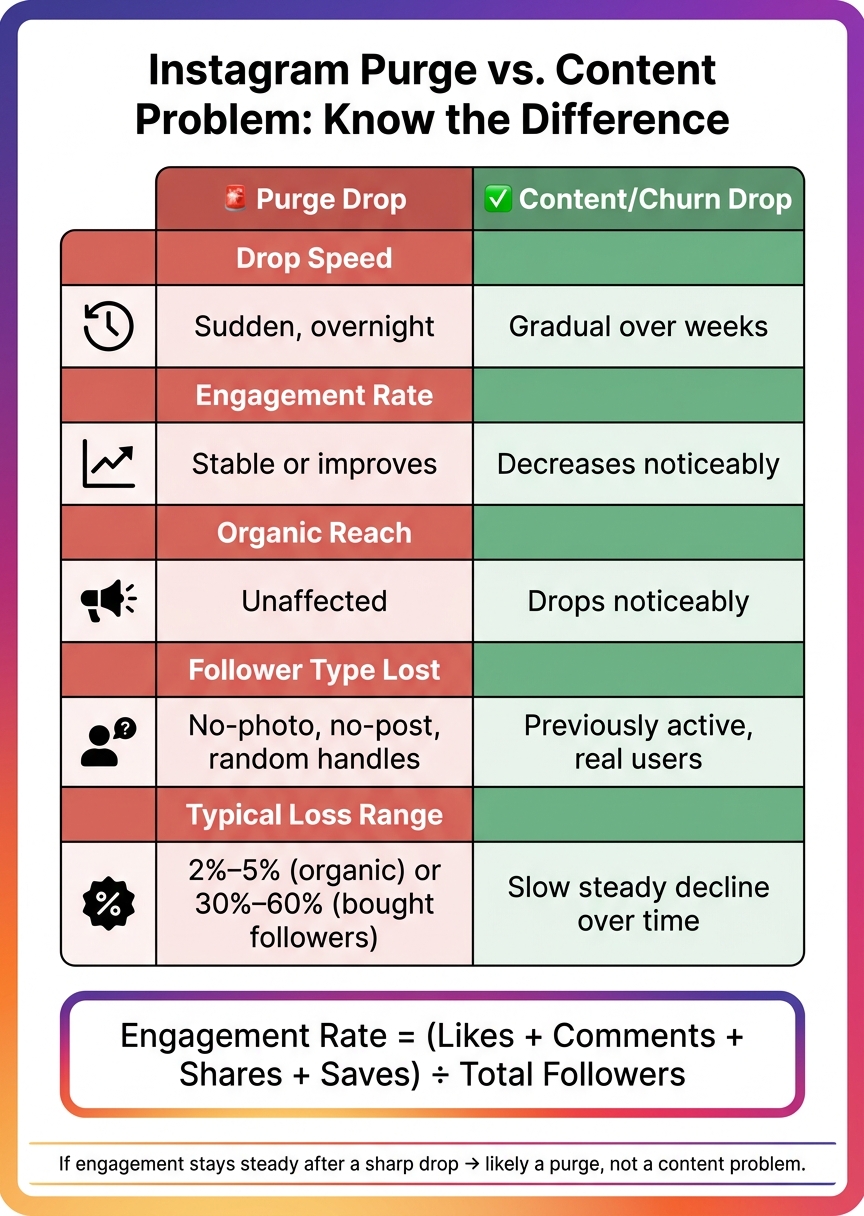
Instagram Purge vs. Content Drop: How to Tell the Difference
Before you blame your content, check if the drop lines up with fake-follower patterns. Start with a manual spot check. Sort your follower list by Most Recent and review about 50 of your newest followers.
Once you know what a purge looks like, a few follower traits usually stand out. No profile photo is the clearest sign. Add a username that looks random - like a first name plus a long string of digits - and there’s a good chance you’re looking at a bot.
Then look at the account history. A profile with zero posts is a warning sign. So is a profile with a few posts all uploaded on one day years ago, followed by silence. Another fast clue is a huge gap between how many accounts they follow and how few followers they have. And if they leave generic, low-effort comments on your posts, that’s often the kind of weak engagement automated accounts leave behind.
Sudden bursts of new followers from places or audiences that have nothing to do with your content are worth a close look too.
Next, check whether the drop happened fast enough to look like a purge. Speed is the biggest clue. Here’s how purge losses and content-driven churn usually look side by side.
| Signal | Purge Drop | Content/Churn Drop |
|---|---|---|
| Drop speed | Sudden, overnight | Gradual over weeks |
| Engagement rate | Stable or improves | Decreases |
| Organic reach | Unaffected | Drops noticeably |
| Follower type lost | No-photo, no-post accounts | Previously active, real users |
If engagement stays steady after a sharp drop, that points more to a purge than a content problem. To double-check, use this formula: (Likes + Comments + Shares + Saves) ÷ Total Followers.
You should also see if other creators in your niche noticed the same thing at the same time. When platforms clear out fake accounts, it often hits many accounts at once. And if you want to rule out account issues on your side, go to Settings → Account Status in the Instagram app to see whether your account has been flagged or restricted.
If the drop fits these patterns, the next move is to clean out fake followers and start building back with real ones.
If the purge hit your account, the fix is pretty simple: remove fake followers and rebuild with real ones. You can't shield fake or bot followers from a purge. The only long-term fix is to clear them out and start growing with actual people. A small number of real followers can still get flagged by mistake, but that's the exception, not the norm.
Cheap bot followers tend to vanish fast. Real followers usually stick around. And that gap becomes obvious during a sweep like the one in May 2026.
| Follower Type | What it looks like | Purge-Removal Risk | Engagement impact | Retention Through Purge | Long-Term Brand Risk |
|---|---|---|---|---|---|
| Cheap fake/bot packages | No posts, scrambled handles, follows thousands | Extremely high | Lowers it (bloats denominator) | Cheap bot packages lose a large share fast | High - visible drops in growth charts |
| Real organic followers | Active posting, human interactions, believable bio | Very low | Increases through active participation | Real followers mostly remain | Low - builds trust |
If your follower list shows those patterns, clean it up before trying to grow again. There's a silver lining here too: removing inactive bots can improve your engagement rate. Why? Because when fake accounts stop inflating the denominator, your real likes, comments, and shares carry more weight.
Instagram lets you remove followers manually and quietly. The other account doesn't get notified, which makes this a clean way to cut dead weight. You should also disconnect any third-party apps that accessed your account through scraping or unauthorized automation. Those tools often trigger integrity flags.
If you want a fast check, use the free Instagram audit tool to look for fake followers. If you'd rather review things by hand, read the guide on how to spot bought followers. And if you've bought followers before, the recovery guide walks through what to do next.
After the cleanup, watch your engagement rate for the next 30 days. A sudden jump in followers followed by a steep drop is a strong sign that a bulk purchase ran into a purge.
Once the cleanup is done, switch from removal to replacement. Real growth replaces purged followers with people who are likely to stay.
UpGrow helps rebuild your audience with real followers through AI-driven growth strategies, human oversight, and compliant growth. No bots. No fake accounts. No password access needed. Its live analytics dashboard shows your results in real time, so you can see who you're reaching and how your account is growing.
No. The accounts removed in the 2026 purge were flagged by Meta as bots, spam, or fake accounts, so in most cases they won't come back.
Your follower count after the purge is simply more accurate. Active, genuine followers are mostly untouched, and a smaller but better audience can help improve engagement signals.
Review your follower list by hand and remove accounts that look off. Common red flags include no profile photo, no posts, or random, jumbled usernames. Start small by checking a sample of your audience before you delete anything.
Skip third-party follower tracker or cleaning apps. They may rely on access methods that can put your account at risk. You're better off putting your time into organic engagement instead.
To help your followers stick around through future purges, steer clear of growth tricks that depend on bot networks, engagement pods, or bought followers. Those are the first things Meta’s AI-led moderation tends to go after.
The best long-term play is simpler: publish original, high-quality content that gets people to share, save, and respond in ways that mean something. And since platform-owned followers can disappear or shift at any time, your safest audience is one you build off-platform too, like an email or SMS list.
Share this post&description=Instagram%20removed%20fake%2C%20bot%2C%20and%20inactive%20accounts%20in%20a%20large%20cleanup%20%E2%80%94%20if%20engagement%20stayed%20steady%2C%20your%20audience%20just%20got%20cleaner.&image=https://www.upgrow.com/blog-images/assets.seobotai.com/cdn-cgi/image/quality=75,w=1536,h=1024/upgrow.com/6a3c898d2902db05ecd7ef1f-1782353746767.jpg)


