Ultimate Guide to Cross-Platform Instagram Story Sharing
Learn how to share Instagram Stories across Facebook, TikTok, Snapchat, YouTube Shorts, Pinterest, X, and LinkedIn—optimize format, timing, and analytics.

Instagram Stories are a great way to connect with your audience, but why limit their impact to just one platform? Sharing your Stories across platforms like Facebook, TikTok, Snapchat, and YouTube Shorts can help you reach a larger audience, save time, and get more value from your content. Here’s how you can make it work:
- What Are Instagram Stories?: Temporary vertical posts (photos/videos) that disappear after 24 hours, with features like stickers, polls, and music.
- Why Cross-Post?: Reach more people, save effort by reusing content, and learn which platforms work best for your audience.
- Challenges: Some content may not fit all platforms, watermarks lower quality, and repetitive posts might bore followers.
- How to Share: Link Instagram to Facebook for automatic sharing. For TikTok, Snapchat, and YouTube Shorts, download and manually upload your Story, tweaking it to fit each platform’s style.
- Optimize Content: Adjust visuals, captions, and features to match each platform’s audience. For example, TikTok favors trending sounds, while LinkedIn requires a professional tone.
- Track Results: Use analytics tools to monitor performance across platforms. Metrics like reach, engagement, and clicks help refine your strategy.
How to cross-post to all social media channels at once (without looking spammy)
Setting Up Accounts and Permissions for Cross-Posting
To make cross-posting seamless, start by linking your Instagram and Facebook accounts through Meta's Accounts Center. Then, fine-tune your account settings to ensure everything runs smoothly.
Connecting Instagram and Facebook via Meta Accounts Center
If you want to share Stories between Instagram and Facebook, your Instagram account needs to be set as either a Creator or Business account. On Facebook, you'll need admin or editor permissions. Here's how to connect them:
- Open Instagram and navigate to Menu › Settings and Privacy › Accounts Center.
- Tap Add Account and select your Facebook Page. If your Page doesn't show up, double-check your permissions.
- Once linked, you'll see an "Also share on Facebook" toggle when creating a new Story. Activating this toggle will automatically share your content on both platforms.
Keep in mind that not all Story formats are compatible with Facebook, so some features may not carry over.
Permissions and Privacy Settings
It's important to review your privacy settings on both platforms. On Instagram, decide whether to share Stories with the public, close friends, or specific followers. On Facebook, ensure your Page's audience settings align with your goals. When accounts are linked through the Accounts Center, audience data may be shared between platforms for analytics purposes. You can always disconnect the accounts if needed.
For platforms outside Meta's ecosystem - like TikTok, YouTube Shorts, or LinkedIn - manual uploads or a trusted social media management tool with proper authentication will be required.
Using UpGrow for Targeted Growth
Once your accounts are set up, tools like UpGrow can help you reach the right audience. UpGrow uses AI-driven targeting to focus on factors like location, age, gender, and language. Its real-time analytics dashboard ensures your cross-posted content is making an impact. Plus, their Boost™ tool attracts followers who match your criteria, helping you grow an audience that aligns with your goals.
How to Share Stories to Each Platform
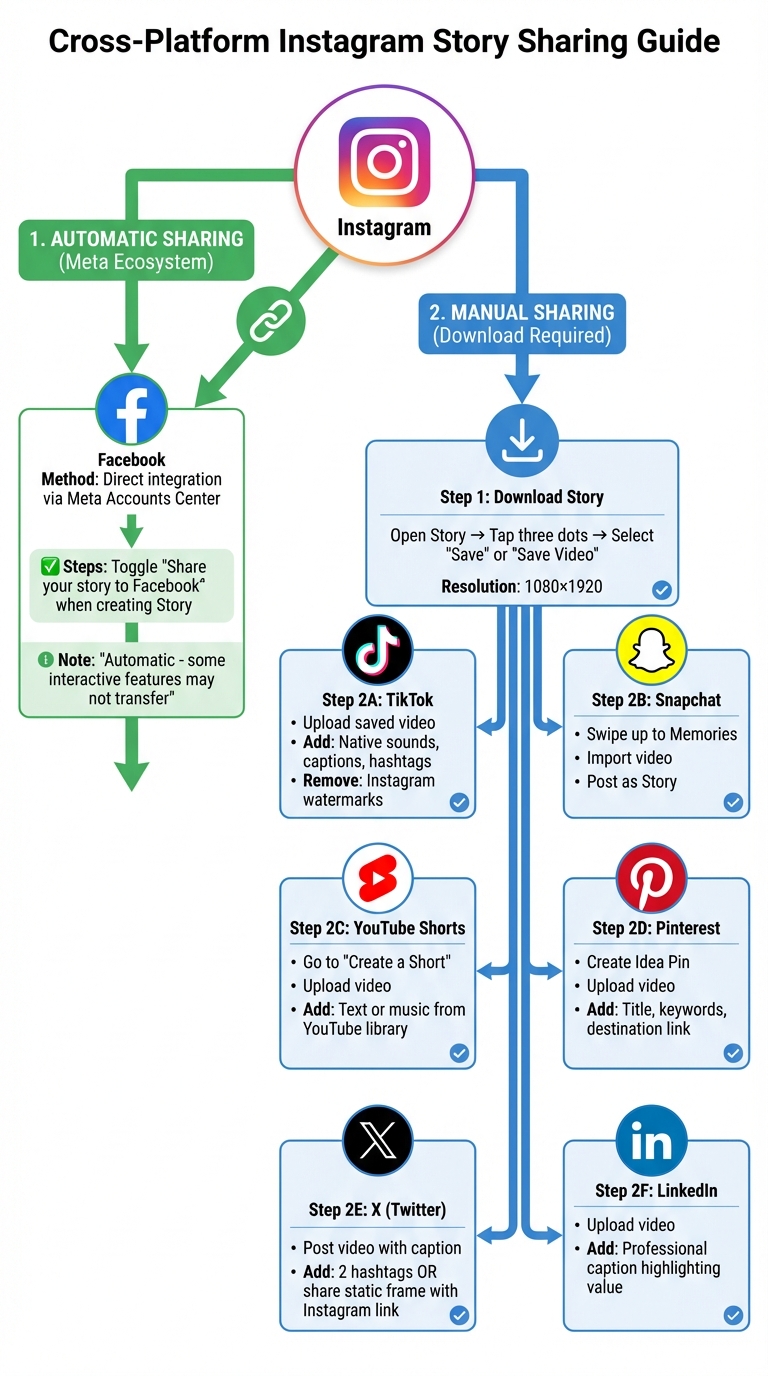
How to Share Instagram Stories Across 7 Social Media Platforms
Now that your accounts are synced, it’s time to focus on sharing Stories across different platforms. Each platform has its own approach - some make it simple with automatic options, while others require a bit of manual effort.
Sharing Instagram Stories to Facebook
Sharing to Facebook is straightforward since both platforms are part of Meta's ecosystem. Once you’ve linked your accounts through the Meta Accounts Center, you’ll notice a toggle labeled "Share your story to Facebook" whenever you create a new Story. Switch it on, and your Story will appear on both Instagram and Facebook at the same time. If you want this to happen automatically every time, you can enable "Always share to Facebook" in your Story settings. Keep in mind that certain interactive features, like polls or question stickers, may not transfer perfectly between the platforms. For platforms outside of Meta’s ecosystem, you’ll need to use manual sharing methods.
Manual Sharing to TikTok, Snapchat, and YouTube Shorts
Instagram doesn’t offer direct sharing to TikTok, Snapchat, or YouTube Shorts, so you’ll need to download your Story first. Open your Story, tap the three dots, and choose "Save" or "Save Video" to download it to your phone. Make sure to save the video in 1080×1920 resolution to maintain high quality.
For TikTok, upload the saved video, then add platform-specific touches like native sounds, captions, and hashtags. Be sure to remove any Instagram watermarks or UI elements for a cleaner look. On Snapchat, swipe up to access Memories, import the video, and post it as a Story. For YouTube Shorts, go to the "Create a Short" section, upload your video, and enhance it with text or music from YouTube’s library.
Sharing to Pinterest, X, and LinkedIn
To share on Pinterest, transform your Story into an Idea Pin. Tap Create, select the Idea Pin format, and upload your video. Add a descriptive title, relevant keywords, and a destination link to direct viewers back to your Instagram or website.
On X (formerly Twitter), post your Story video with a concise, engaging caption and a couple of hashtags, or share a static frame from your Story with a link to Instagram. For LinkedIn, upload your Story video with a caption that highlights its relevance or value to your professional audience. These steps ensure your content is tailored for each platform, setting the stage for more advanced strategies in the next section.
sbb-itb-3c55afb
Optimizing Story Content for Each Platform
Adapting Content for Different Platform Audiences
Every platform has its own unique flavor, and your Stories need to fit right in. On Instagram and Facebook, keep things visually engaging with minimal text, emojis, stickers, and short captions. These platforms thrive on aesthetics and simplicity. For TikTok and Snapchat, lean into trending audio, quick edits, and bold on-screen text. These are spaces for fun, high-energy content, so don’t shy away from using native filters and effects to match their playful vibe.
YouTube Shorts, on the other hand, calls for a polished approach. Grab attention within the first couple of seconds with a strong hook, and make sure your content delivers value. Adding captions is key here, as many users watch without sound. Pinterest is a whole different ballgame - clean, inspirational visuals with minimal text are what work best. Focus on "how-to" ideas or aesthetically pleasing content that aligns with Pinterest’s discovery-driven audience. For X (formerly Twitter), go for bold, concise text and keep distractions to a minimum. On LinkedIn, a professional tone is essential. Use data-driven visuals and text that highlight industry insights or career-focused content.
Best Practices for Timing and Frequency
Timing and consistency are everything when it comes to Stories. On Instagram and Facebook, aim for 3–5 posts spread throughout peak active hours. For TikTok and Snapchat, 1–3 Stories during lunch or in the evening work well. YouTube Shorts perform better with 1–2 posts in the late afternoon or early evening. Pinterest is ideal for weekend or weekday morning posts, while X and LinkedIn are most effective during standard business hours (9 AM–5 PM).
Resist the urge to blast the same Story across all platforms at the same time. Instead, stagger your posts by 1–2 hours to hit each platform’s peak engagement window. To keep your audience interested, limit cross-posting of the same Story to 2–3 platforms and vary your content themes - mix in behind-the-scenes glimpses, tips, and promotions throughout the week.
Using UpGrow's Tools for Viral Content
UpGrow’s tools are designed to take your Story game to the next level. The viral content library offers proven templates and formats that have already driven real engagement on Instagram. You can analyze which visuals, text styles, and calls-to-action perform best, then tweak them for other platforms. For example, the Boost™ tool helps identify which Story formats resonate most with your audience. Beta users have reported a 275% jump in monthly followers by tapping into this AI-powered feature.
Take high-performing Instagram content and repurpose it for other platforms by tailoring platform-specific elements. UpGrow’s real-time analytics dashboard tracks which Story formats drive the most profile visits and engagement. This data lets you focus on what works, refine your strategy, and ensure your cross-platform efforts are as effective as possible. By monitoring and adjusting through unified analytics, you can keep fine-tuning your approach for even better results.
Tracking Performance and Refining Your Strategy
Understanding Platform Analytics
Though each platform tracks Stories a bit differently, the core metrics tend to overlap. Take Instagram, for example: you’ll want to monitor reach (how many unique accounts saw your Story), taps forward and backward (how users navigate through your slides), exits (where viewers drop off), replies, and link clicks. If your opening slide grabs attention but later slides lose viewers (low taps forward or high exits), it’s a sign those slides need tweaking - or maybe even cutting altogether.
On Facebook Stories, which you can analyze through Meta Business Suite, the focus shifts to reach, reactions, replies, and link clicks. Comparing these metrics to Instagram can provide insights into how your content resonates with different audiences. Over on TikTok, engagement metrics like rewatches, comments, saves, and shares take center stage. Meanwhile, YouTube Shorts prioritizes watch time and average view duration, and Pinterest places emphasis on saves and outbound clicks.
Creating a Unified Analytics Framework
To truly understand how your Stories perform across platforms, you need a consistent system. Start by using standardized UTM parameters for every Story link. For instance, when posting on Instagram, you might tag links like this:
- utm_source=instagram_story
- utm_medium=story
- utm_campaign=product_launch
You can apply the same structure for other platforms, simply swapping out the source (e.g., "facebook_story" for Facebook, "tiktok_story" for TikTok). This approach ensures that tools like Google Analytics can clearly show which platforms are driving the most traffic and conversions.
Next, consolidate all your metrics in one place - like a spreadsheet. Include columns for Platform, Date, Story Title, Reach, Engagement (taps, replies, shares), Link Clicks, and Conversions. Update it weekly with native metrics from each platform. Calculate engagement rates (engagements ÷ reach × 100) to compare performance. For example, if an Instagram Story reaches 10,000 users and gets 500 taps (5% engagement rate), while a Facebook Story reaches 8,000 users with 200 taps (2.5% engagement rate), you can see Instagram is driving better engagement for that specific content.
Once your data is unified, tools like UpGrow’s real-time dashboard can help you act on trends quickly.
Using UpGrow's Real-Time Dashboard
A centralized analytics tool like UpGrow gives you the ability to adjust your strategy on the fly. With its real-time dashboard, you can see how your Instagram Stories are impacting follower growth and engagement. It tracks key metrics like Story reach and engagement rate while also offering demographic insights - such as location, age, gender, and peak activity times - to help you refine your content for maximum impact.
The real-time feedback is invaluable. For instance, if a specific Story format is consistently boosting engagement and follower growth on Instagram, you can adapt it for Facebook or TikTok with minor tweaks tailored to those platforms. The dashboard also highlights trends, helping you double down on what works while cutting out what doesn’t - all in real time. This keeps your cross-platform strategy sharp and focused, ensuring you’re always optimizing for the best results.
Conclusion
Cross-platform sharing is all about meeting your audience where they are and making the most of every piece of content. By connecting your accounts, tailoring posts to fit each platform, and using unified analytics to track performance, you can expand your reach well beyond just one channel. The trick is finding the right balance - repurpose the same core content, but adjust the tone, format, and calls-to-action to suit the unique audience and features of each platform.
Tools like UpGrow make this process even smoother. With AI-driven targeting that factors in location, age, gender, and interests, plus real-time analytics to measure how your Stories influence follower growth and engagement, you can tweak your strategy on the fly. Add to that UpGrow's viral content library, filled with trending ideas, and you've got everything you need to keep your Stories relevant and engaging across platforms. These methods are backed by solid industry data.
For instance, cross-platform strategies have been shown to boost engagement by up to 3x, according to the Buffer State of Social 2024 report. Additionally, 72% of marketers say that repurposing content is one of their biggest time-savers (HubSpot Marketing Trends Report 2024). And with over 500 million accounts viewing Instagram Stories daily (Meta, 2023), a well-thought-out sharing strategy can significantly amplify your reach.
If you're just starting out, focus on two or three platforms where your audience is most active. Adjust your captions, hashtags, and content to fit each platform's vibe, and keep an eye on which channels drive the best results. Whether you're a solo creator or juggling multiple accounts, smart cross-posting combined with AI tools can turn fleeting Stories into powerful tools for growing your audience and boosting engagement.
FAQs
How can I make sure my Instagram Stories perform well on different platforms?
To make your Instagram Stories work seamlessly across different platforms, it's important to adjust your content to match the preferences and habits of each platform's audience. Tools like AI-powered targeting can help you connect with the right viewers by considering factors like location, age, gender, and language. At the same time, aim for visuals and messaging that stay consistent but flexible enough to fit the unique features of each platform.
If you're looking to grow organically and boost engagement, focus on strategies that encourage genuine interactions. Using advanced analytics and targeting tools can fine-tune your approach, helping your Stories reach more people effectively across various platforms.
What are the biggest challenges when sharing Instagram Stories across platforms?
Sharing Instagram Stories on other platforms can be a bit challenging due to differences in formats, features, and audience preferences. For instance, Instagram Stories are designed for vertical viewing, which might not look great on platforms with different aspect ratios. Plus, some platforms may not support interactive elements like polls or stickers, which could reduce engagement opportunities.
Another hurdle is ensuring consistent branding and messaging across different platforms. Each platform has its own vibe and audience expectations, so content that works on Instagram may not connect the same way elsewhere. The key is to tailor your Stories for each platform while staying true to your brand's identity. This approach helps ensure your content remains engaging and effective, no matter where it’s shared.
What’s the best way to track how my cross-platform Instagram Stories are performing?
To keep tabs on how well your cross-posted Instagram Stories are performing, leverage real-time analytics tools that deliver in-depth insights. For instance, UpGrow provides a live dashboard that lets you monitor key metrics such as reach, engagement, and follower growth - all updated instantly. This way, you’ll always know what’s resonating with your audience and can tweak your approach to get the best results.