Instagram Data Collection: Legal Bases Explained
Explore the essentials of GDPR compliance for Instagram data collection, focusing on legal bases, user privacy, and recent enforcement actions.

Instagram's data collection practices must align with GDPR, a law that protects personal data and privacy in the EU. Here’s what you need to know:
- GDPR Basics: Enforced in 2018, GDPR applies to any company handling data of EU residents, regardless of location. Fines for non-compliance can reach €20 million or 4% of global revenue.
- Legal Bases: Instagram relies on GDPR’s six legal bases for data collection, primarily consent and legitimate interests. Consent is required for marketing activities, while legitimate interests cover operational needs like analytics.
- Recent Cases: Meta (Instagram’s parent company) faced €390M in fines for improper ad targeting and €405M for exposing minors’ data. These highlight the risks of non-compliance.
- Compliance Tips: Secure explicit user consent, limit data collection to what’s necessary, and update privacy policies regularly. Avoid pre-checked consent boxes and ensure users can easily withdraw consent.
Key takeaway: Understand GDPR’s rules, choose the right legal basis for data collection, and prioritize user privacy to avoid fines and protect your brand.
6 Legal Bases for Data Collection under GDPR
Complete List of the 6 Legal Bases
Under Article 6(1) of GDPR, there are six distinct legal bases organizations can use to justify the collection and processing of personal data. Each has its own purpose and requirements:
- Consent: Users must actively agree to data collection. Consent must be freely given, informed, and easy to withdraw.
- Contract: Data processing is allowed when necessary to fulfill a user’s request, such as delivering a service they’ve purchased.
- Legal obligation: Covers situations where processing is required by law.
- Vital interests: Applies when processing is essential to protect someone’s life or physical safety.
- Public task: Used by government bodies or organizations performing duties in the public interest.
- Legitimate interests: Allows businesses to process data for their operational needs, as long as this does not override users’ rights and privacy.
For Instagram, data collection often relies on consent or legitimate interests, both of which directly shape how data is used, what rights users have, and what documentation is required. Understanding these bases is key to aligning Instagram’s practices with GDPR requirements.
Top Legal Bases for Instagram Users and Marketers
When it comes to processing personal data under GDPR, consent and legitimate interests are the most commonly used legal bases.
- Consent works best for non-essential data collection, such as marketing emails, tracking cookies, or gathering extra profile details. It must be explicit and easy for users to withdraw.
- Legitimate interests provides more flexibility for routine business operations. It’s suitable when there’s a genuine business need for the data, and processing is necessary for that purpose - so long as users’ privacy rights aren’t compromised. However, businesses must conduct a Legitimate Interest Assessment (LIA) to balance their needs against potential privacy impacts and document their justification.
Another commonly used basis is contractual necessity, which applies when processing is required to fulfill a service or agreement with the user.
Recent Legal Changes Affecting Instagram
Recent legal developments have highlighted the importance of choosing the right legal basis to avoid risks. These cases demonstrate how decisions about legal bases can have immediate consequences for platforms like Instagram.
In January 2023, the Irish Data Protection Commission fined Meta €390 million for failing to establish a proper legal basis for processing personal data for personalized ads. The ruling found that Meta improperly tied access to essential services with consent for personalized advertising, violating GDPR’s requirement that consent must be freely given and unconditional.
In May 2024, X (formerly Twitter) faced complaints across Europe for using European users’ data to train its "Grok" AI technology without obtaining explicit consent. These incidents emphasize the need to clearly separate essential data usage from optional processing activities.
With the average GDPR fine in 2023 reaching €4.4 million, selecting the right legal basis has become more critical than ever. For Instagram marketers, these recent legal actions suggest that relying on legitimate interests for advertising carries increased risks. Explicit consent, while potentially reducing the amount of data collected, offers a safer, more compliant path forward.
Getting started with GDPR compliance: Introduction to the GDPR
How to Stay Compliant: Steps for Instagram Users and Marketers
Staying on the right side of GDPR when collecting data through Instagram requires careful planning and execution. The €405 million fine Instagram faced in September 2022, handed down by the Irish Data Protection Commission, serves as a stark warning. This penalty was tied to the platform's failure to protect children's privacy, specifically by making their contact information public by default. To avoid similar pitfalls, users and marketers must prioritize obtaining and documenting clear, informed consent from individuals.
Getting and Recording User Consent
At the heart of GDPR-compliant data collection lies explicit, informed consent. Before you activate any Instagram-related tools or features that gather user data, you must secure active agreement through clear consent mechanisms. This typically involves a deliberate action, like clicking an "Accept" button, ensuring the user fully understands what they’re agreeing to.
A proper consent flow begins with transparency. When users visit your site and engage with Instagram content, present them with a pop-up or banner explaining what data will be collected and why - before any Instagram features load. Make it clear that enabling Instagram integrations will share certain data with Meta Platforms, and outline the specific purposes for this data sharing.
Equally important is documenting this consent. Keep records that include timestamps, the exact language used, and details about how the data will be processed. These records are crucial for demonstrating compliance during audits.
Users should also have the freedom to withdraw consent as easily as they gave it. Provide straightforward options, such as an opt-out link or a settings dashboard. Once consent is revoked, stop processing their data immediately, and ensure it is either deleted or anonymized. And remember - never use pre-checked boxes or make withdrawing consent harder than opting in.
Updating Privacy Policies and User Notifications
Your privacy policy is more than just a legal formality - it’s a key tool for transparency. Regularly review and update it to reflect your current data practices. Clearly explain what data you collect through Instagram integrations, why you collect it, the legal grounds for doing so, and any data-sharing arrangements with Meta Platforms. The language should be simple enough for anyone to understand, avoiding legal jargon wherever possible.
In addition, provide real-time notifications at the point of data collection. If someone interacts with Instagram content on your platform, give them clear information about their rights and how their data will be used. If you introduce new features or decide to share data with additional parties, notify users promptly.
Protecting Sensitive Data and Limiting Data Collection
Consent and transparency are just the start. Limiting the amount of data you collect is another crucial step. GDPR’s principle of data minimization means you should only gather the information absolutely necessary for your specific purpose. This approach not only reduces risks but also demonstrates your commitment to privacy standards.
Handling data from minors requires extra care. If your Instagram integrations may involve users under 18, implement additional safeguards to ensure sensitive details - like contact information - remain private unless explicitly shared by the user.
Regular audits are essential for spotting areas where you might be collecting unnecessary data or falling short on compliance. Review your Instagram integrations periodically to ensure you’re only gathering what’s essential and that your legal bases for processing data remain valid.
Lastly, embed privacy considerations into your campaigns from the very beginning. Before launching any new Instagram features or marketing strategies, conduct data protection impact assessments. This will help you identify potential risks and find ways to mitigate them. For example, consider whether anonymized analytics could meet your goals without tracking individual users.
If you’re processing data jointly with Meta through Instagram tools, establish clear agreements that outline responsibilities, particularly regarding data subject requests and compliance obligations. Article 26 of GDPR requires such agreements to ensure accountability and proper handling of shared data.
Instagram-Specific Compliance Challenges and Legal Risks
Instagram's unique features and its integration with Meta bring a distinct set of compliance challenges. The platform’s emphasis on visuals, social interactions, and its connection to Meta’s ecosystem introduces risks that both users and marketers must navigate carefully to avoid serious violations. These risks are especially evident when examining recent enforcement actions.
Major Enforcement Cases and Fines
One of the most prominent GDPR enforcement actions involving Instagram took place in September 2022, when the Irish Data Protection Commission imposed a massive €405 million ($405 million) fine on Instagram for mishandling children’s data. The investigation found that Instagram allowed children aged 13 to 17 to set up "business accounts." This automatically exposed their personal contact information - like phone numbers and email addresses - due to default public settings. Additionally, child accounts were set to "public" by default, requiring users to manually switch to "private."
"This was a major breach that had significant safeguarding implications and the potential to cause real harm to children using Instagram. The ruling demonstrates how effective enforcement can protect children on social media and underlines how regulation is already making children safer online."
- Andy Burrows, child-safety-online policy head, National Society for the Prevention of Cruelty to Children (NSPCC)
Instagram has also faced legal challenges in the United States. In June 2024, Illinois residents who had used Instagram between August 10, 2015, and August 16, 2023, began receiving settlement payments from a $68.5 million class-action lawsuit. This lawsuit alleged that Instagram violated Illinois' Biometric Information Privacy Act (BIPA) by collecting biometric data without proper consent. As part of the settlement, each claimant received $32.56.
These cases highlight a growing trend: enforcement actions are becoming more frequent and severe. For instance, EU Data Protection Authorities issued nearly €1.1 billion in fines during the 12 months leading up to January 2022.
Common Compliance Mistakes on Instagram
Marketers and users of Instagram often make critical compliance errors, exposing themselves to legal risks. One common misstep is failing to obtain proper consent through compliant privacy policies. Many businesses neglect to clearly explain what data their Instagram integrations collect, how it is shared with Meta, and what rights users have over their data.
Another frequent violation involves using pre-checked consent options, which directly contradict GDPR rules. GDPR mandates that consent must be active and explicit, meaning users must take deliberate action to agree to data processing. Pre-selected options or default data collection settings are not allowed.
Marketers also tend to over-collect data. Instagram's platform offers a wealth of information - photos, location data, interaction patterns, and demographics - which can tempt businesses to gather more than they need. However, GDPR’s data minimization principle requires that only the necessary data for a specific purpose be collected.
Bundling terms and conditions with privacy policies is another compliance pitfall. Users must be able to understand and consent to data processing separately from accepting service terms. When these documents are combined, it becomes harder for users to make informed decisions about their data.
Many businesses fail to verify the GDPR compliance of third-party tools used for Instagram marketing. Tools like analytics platforms, scheduling software, and advertising services often process user data, and if these tools are non-compliant, businesses can be held liable.
Cookie walls, which block access to Instagram content unless users accept all cookies, also violate GDPR. Consent must be freely given, meaning users should have a genuine choice without being penalized for refusing data collection.
Lastly, businesses often struggle to respect user rights. When users request access to their data, corrections, or deletions, companies must respond promptly and thoroughly. Poor processes for handling such requests can lead to ongoing compliance risks.
Avoiding these mistakes is crucial for maintaining GDPR-compliant practices on Instagram.
Comparison Table: Legal Bases for Instagram Data Collection
The table below outlines how different legal bases apply to Instagram’s data collection challenges.
| Legal Basis | Best Use Cases | Advantages | Disadvantages | Instagram-Specific Considerations |
|---|---|---|---|---|
| Consent | Marketing campaigns, contests, lead generation | Clear user permission, strong legal protection | Can be withdrawn anytime, requires active management | Key for targeted ads; must be obtained separately from Instagram's own consent |
| Contract Performance | Account creation, service delivery, payment processing | Stable legal basis, no need for ongoing consent | Limited to necessary contract functions | Rarely relevant for marketing activities on Instagram |
| Legitimate Interests | Analytics, fraud prevention, security monitoring | Flexible; doesn’t require explicit consent | Must pass a balancing test; higher risk | Not suitable for behavioral ads; requires careful assessment |
| Legal Obligation | Tax reporting, law enforcement requests, regulatory compliance | Strong justification; mandatory processing | Very limited scope; no flexibility | Applies mainly to business account holders with specific reporting duties |
| Vital Interests | Emergency situations, life-threatening circumstances | Allows processing without consent in emergencies | Extremely narrow application | Rarely relevant for Instagram marketing |
| Public Task | Government agencies, public sector organizations | Clear authority for public bodies | Only applicable to official public functions | Limited to government accounts performing official duties |
From the table, it’s clear that consent is the cornerstone for most Instagram marketing activities, especially those involving targeted advertising or data sharing with third parties. However, no matter which legal basis is used, businesses must implement strong privacy safeguards. Even when relying on legitimate interests, companies need to carefully balance their goals against user privacy to avoid undermining trust - especially when vulnerable groups, like children, are involved.
sbb-itb-3c55afb
Using UpGrow for Secure and Compliant Instagram Growth
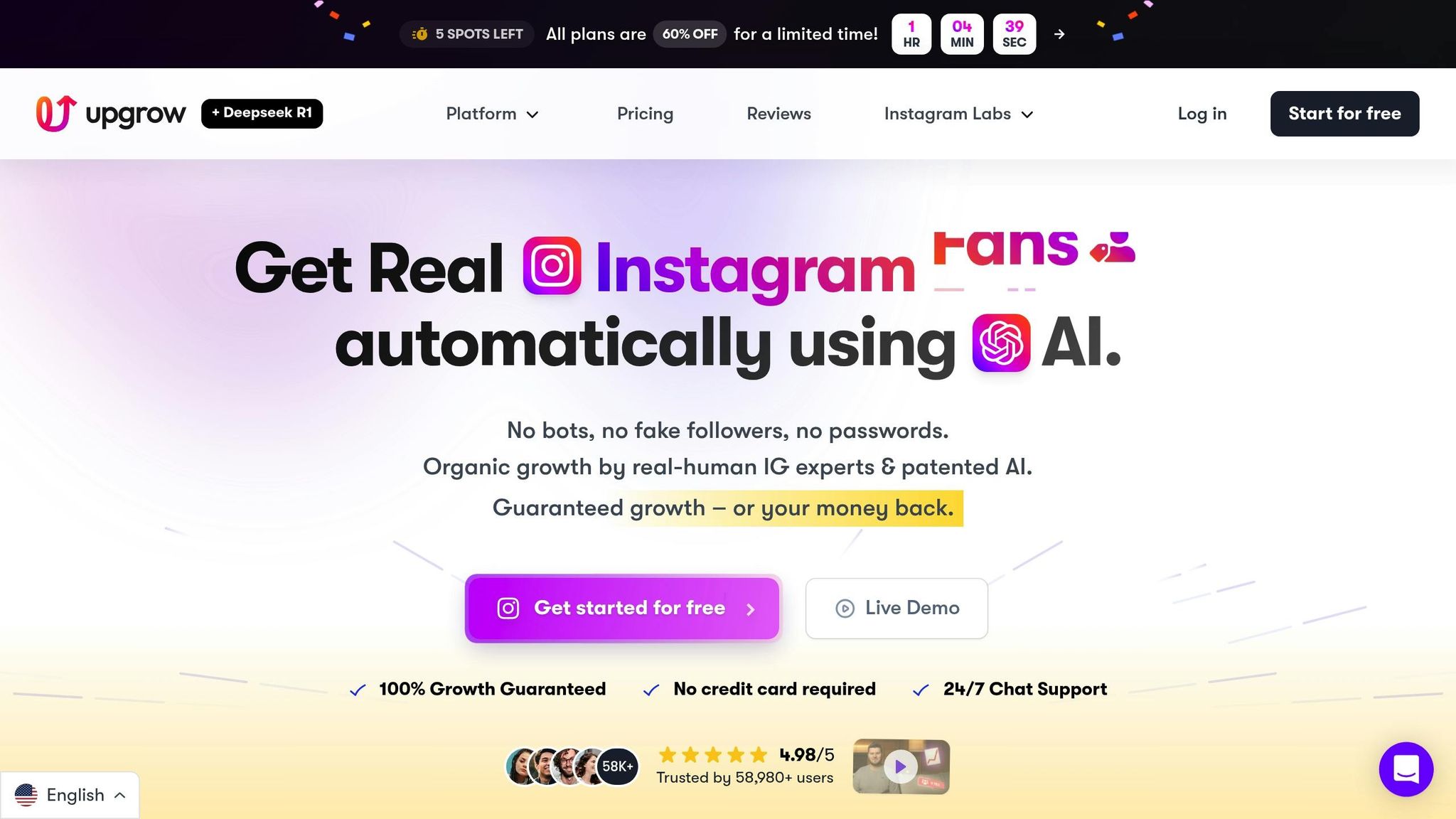
UpGrow offers a practical solution for growing your Instagram presence while staying on the right side of GDPR regulations. By addressing compliance challenges head-on, UpGrow provides a way to achieve organic growth without compromising on data privacy or security. Its AI-driven tools ensure a balance between expanding your reach and protecting user information.
How UpGrow Meets GDPR Requirements
UpGrow places a strong emphasis on safeguarding user data through advanced encryption and strict adherence to GDPR principles, including data minimization practices. One standout feature? It never asks for Instagram passwords, ensuring an added layer of account security.
The platform’s privacy policy clarifies exactly what personal data it collects - such as email addresses, names, phone numbers, cookies, and usage data. This information is used solely for essential functions like maintaining the service, notifying users of updates, providing customer support, improving features, monitoring usage, and addressing technical issues.
These privacy measures are seamlessly integrated into UpGrow’s features, making secure Instagram growth not just possible but highly effective.
UpGrow's Privacy-First Tools and Features
UpGrow’s tools are designed with privacy at their core. Its AI-powered targeting lets users filter audiences by interests, location, hashtags, gender, and age - all while respecting data privacy. The real-time analytics dashboard makes it easy to track growth and engagement as they happen.
Additional features include 24/7 growth monitoring and the Boost™ tool, which drives organic follower growth in a GDPR-compliant way. For agencies, UpGrow offers specialized solutions, such as a viral content library, content creation tools, and strict data segregation protocols.
With pricing starting at $39 per month, UpGrow also includes a growth guarantee, focusing on attracting followers who actively engage with posts and stories. By embedding privacy protections into every aspect of the platform, UpGrow proves that marketing effectiveness and GDPR compliance can go hand in hand. It’s a clear example of how to thrive in today’s regulatory landscape while achieving measurable results.
Conclusion: Main Points for GDPR-Compliant Instagram Data Collection
Navigating GDPR compliance in Instagram marketing requires balancing legal requirements with practical data protection measures. By prioritizing user privacy, businesses can establish marketing practices that are both effective and trustworthy.
At the heart of GDPR-compliant Instagram marketing are three key principles: obtaining explicit consent, maintaining transparency, and respecting user rights. Whether collecting data through Instagram campaigns, lead forms, or third-party tools, every piece of personal information must have a clear legal basis. Users should always understand how their data is being used and have the ability to manage it.
Equally important is the principle of data minimization. Only collect the information absolutely necessary for your marketing efforts, and regularly review your data-handling practices to ensure compliance. Users also have the right to access, update, or delete their personal data at any time. Establishing clear and efficient processes to handle these requests is essential to avoid potential violations.
The tools you choose for growth can significantly influence your compliance efforts. For example, platforms like UpGrow demonstrate that effective Instagram marketing and privacy-focused design can coexist. By embedding data protection features - such as AI-driven targeting and real-time analytics - these tools show how businesses can achieve growth while staying compliant.
GDPR compliance isn’t a one-time task; it’s an ongoing commitment. Regularly update your privacy policies, monitor the compliance of third-party tools, and stay current with regulatory changes. Remember, non-compliance can lead to fines of up to 4% of global annual revenue or €20 million, making adherence not just a legal obligation but a smart business decision.
As Instagram marketing continues to evolve, the principles of consent-based and transparent data collection will remain fundamental. By embedding these practices into your strategy now, you’re not just mitigating legal risks - you’re laying the foundation for sustainable growth in a privacy-aware world.
FAQs
How does Instagram comply with GDPR when collecting user data?
Instagram aligns with GDPR requirements by obtaining clear user consent before collecting personal data. Users must actively opt in, ensuring they are fully aware and agreeable to the data collection process. The platform also emphasizes clarity by detailing its data practices in its Data Policy and offering tools that let users access, download, and manage their personal information.
On top of that, Instagram empowers users to exercise their data rights, providing options to control how their information is used. These efforts demonstrate Instagram's dedication to following GDPR rules and protecting user privacy.
What are the risks for businesses on Instagram if they fail to manage user consent under GDPR?
The Risks of Ignoring GDPR Compliance
Neglecting to handle user consent properly under GDPR can hit businesses hard. The financial penalties alone are daunting - fines can climb as high as $22 million or 4% of a company’s annual global revenue, whichever is greater. But the damage doesn’t stop there. Mishandling data can tarnish your reputation and erode customer trust, which are much harder to rebuild and can stifle long-term growth and loyalty.
On top of that, poor data management significantly raises the chances of privacy violations and data breaches. These incidents don’t just hurt your credibility; they can also lead to costly legal battles. To steer clear of these pitfalls, it’s essential to align your Instagram data collection practices with GDPR standards and make user privacy a top priority.
Why do Instagram marketers need to understand the difference between consent and legitimate interests under GDPR?
Understanding Consent and Legitimate Interests for Instagram Marketers
For Instagram marketers navigating GDPR regulations, knowing the difference between consent and legitimate interests is critical to staying compliant and avoiding legal trouble.
Consent means users must provide clear and explicit permission before their personal data can be processed. This approach prioritizes transparency and gives users full control over how their data is used.
Legitimate interests, on the other hand, allow marketers to process data without explicit consent - but only under specific conditions. The purpose must be valid and cannot override the user's rights or freedoms.
By carefully assessing and documenting the legal basis for processing data, marketers can not only safeguard user privacy but also build stronger trust with their audience. Aligning with GDPR guidelines helps reduce the risk of penalties and supports long-term success on Instagram.