
Comment Downvotes & Brand Safety: Preparing for Instagram’s Private Dislike Button
Instagram's private dislike button aims to reduce toxic interactions but poses new challenges for brands in managing reputation and engagement.
Instagram's private dislike button aims to reduce toxic interactions but poses new challenges for brands in managing reputation and engagement.
4.98 /5 - from 58k reviews
Trusted by 50,000+ creators — get real engagement delivered to your profile in minutes, not days.
Instagram is testing a private dislike button for comments, aiming to reduce toxic interactions. Unlike public downvotes, these dislikes are invisible to others and only seen by the commenter and Instagram's moderation team. Here's what you need to know:
Instagram's private dislike button was designed to promote healthier online interactions, but it comes with challenges for brands striving to safeguard their reputation and maintain engagement. The hidden nature of this feedback system can create significant blind spots, impacting brand safety and content performance in ways that aren’t immediately obvious.
One of the biggest concerns is how private dislikes can quietly harm a brand's reputation. Unlike visible metrics that allow brands to gauge public sentiment, private dislikes operate out of sight. This lack of transparency can allow negative opinions to grow unchecked, slowly eroding trust in a brand.
Early detection of potential issues becomes harder, too. Brands often rely on visible engagement metrics to identify problems before they escalate. Without this transparency, warning signs might go unnoticed, leaving brands unprepared to manage a brewing crisis. This hidden feedback system doesn't just pose risks to brand safety - it also affects how content is seen and engaged with.
Private dislikes impact more than just reputation; they also influence how content is prioritized by Instagram's algorithm. Disliked comments are pushed down, which can lead to a decrease in organic reach. This change can ripple through a brand’s overall content performance. For instance, if supportive comments are buried beneath neutral or less favorable ones, the tone of the conversation around a post may shift, altering public perception.
Instagram’s algorithm also weighs engagement quality when deciding how widely to distribute content. A pattern of private dislikes could lead to a reduction in organic reach - even if the brand is unaware of the negative feedback. Research from similar systems shows that community moderation can reduce toxic comment visibility by up to 45%. While this may sound like a positive outcome, it also means brands must work harder to create content that resonates positively with their audience to avoid being penalized by the algorithm.
Another significant risk is the potential for organized negative campaigns. The private nature of dislikes doesn’t eliminate the threat of coordinated attacks - it makes them harder to detect. Bad actors, including bot networks and AI-generated accounts, can systematically target brands with private dislikes, leaving no visible trace. Unlike public dislike systems where unusual activity might be flagged, private dislikes allow these actions to fly under the radar.
Studies on similar platforms highlight troubling trends. For example, while "How to" and "Crafts" videos saw overall engagement increase with the introduction of dislike buttons, dislikes grew at a faster rate than likes. Meanwhile, gaming content had the lowest proportion of dislikes relative to total engagement, at just 2.8%. These findings suggest that certain industries or content types may be more vulnerable to coordinated dislike campaigns.
For brands, these orchestrated attacks can be especially damaging. A well-coordinated campaign of private dislikes could suppress positive feedback and amplify negative sentiment without the brand even realizing it. By the time reduced engagement or reach becomes noticeable, the harm to reputation may already be done. Traditional strategies that rely on visible metrics to separate genuine feedback from malicious activity lose effectiveness, leaving brands with fewer tools to counter such attacks effectively.
Instagram's private dislike button doesn’t have to spell trouble for your brand. With the right strategies and tools, you can turn it into an opportunity to strengthen your connection with your audience. The secret? Be proactive - use technology to gather insights and create content that resonates with your followers. Tools like AI-driven sentiment analysis can help you stay ahead.
AI-powered sentiment analysis offers a way to uncover hidden feedback. These tools analyze comments, reviews, and social media mentions to detect emotions, providing insights that go beyond traditional metrics.
Take the Atlanta Hawks, for example. They used sentiment analysis through Sprout Social to refine their social media strategy. The result? A 127.1% increase in video views and a 170.1% boost in audience growth within just three months. Similarly, Nike monitors social media in real time to track brand mentions and feedback. This allows them to address concerns quickly and tailor content to deliver more personalized experiences.
For the best results, pull data from multiple sources - social media, online reviews, surveys, and customer support interactions. This provides a fuller picture of how your audience feels. Before diving into sentiment analysis, define clear goals, whether it’s improving customer service, measuring campaign success, or gauging overall brand perception.
Sentiment analysis tools come at different price points. For instance, Brand24 starts at $149 per month, while Sprout Social begins at $199 per user per month, with additional costs for AI features. While these tools require investment, they can quickly pay off. Research shows that 59% of consumers will stop supporting a brand after several negative experiences, and 17% will leave after just one bad interaction. By identifying potential issues early, you can address them before Instagram’s private dislikes affect your content’s visibility.
Moderation isn’t just about deleting negative comments - it’s about fostering a positive, engaging environment while addressing concerns before they escalate.
Timing is critical. Responding to comments within 24 hours shows attentiveness and helps manage issues effectively. For example, Apple Support responded to a distressed customer within three hours, directing them to private messages for a swift resolution.
When handling criticism, stay calm and professional, even if the comment feels unfair. Show empathy by acknowledging the commenter’s feelings, which reinforces that you value their input. Brands like Patreon and Airbnb excel at this. Patreon issued a concise, heartfelt apology, while Airbnb provided prompt, detailed responses to ease customer frustrations.
Instagram’s comment filters are another valuable tool. Use them to block offensive language and remove harmful or spammy comments. Additionally, smart hashtag use and consistent posting can improve your comment environment. Relevant hashtags help Instagram’s algorithm index your content, while consistent posting keeps you visible to engaged followers. Combining sentiment insights with active moderation creates a solid foundation for content that minimizes negative interactions.
The best way to avoid private dislikes? Create content that genuinely connects with your audience. This requires knowing not only what they want to see but also how they prefer to engage.
Start by fine-tuning your content formats. Carousel posts, for instance, are among the most engaging types of Instagram content. They’re perfect for storytelling or educational posts. Make sure your carousel copy encourages users to scroll through every slide. For video content, grab attention right away with a strong hook in the first three seconds. Keep Reels under 90 seconds and loop them to boost watch time.
"The algorithm will start prioritizing and rewarding content that is original and creative."
– Eileen Kwok, Social Marketing Specialist at Hootsuite
Content like tips, checklists, and tutorials often prompts users to save posts, encouraging positive engagement.
Authenticity matters more than perfection. As Jordan Seals, Social Marketing Manager at GhostBed, notes:
"All too often companies focus on curating the perfect Instagram grid. While aesthetically pleasing from a branding standpoint, this does little to build a community."
Everlane is a great example of this approach. They use surveys and audience engagement to understand their followers better. Their content features natural, relatable images of a diverse customer base and includes an annual impact report to show how their customers’ actions contribute to meaningful change.
For social SEO, write keyword-rich captions and use alt text to help Instagram’s AI understand your content better. Pair this with relevant hashtags to ensure your posts reach the right audience. Engaging with accounts in your niche also boosts visibility and helps Instagram contextualize your content. With these strategies, you can reduce the chances of private dislikes while building stronger connections with your audience.
Instagram's private dislike button has made managing comments with AI tools more important than ever. While these dislikes remain invisible to users, AI tools can analyze patterns in comments, engagement rates, and overall sentiment to provide insights into how your content performs. These tools can sift through thousands of mentions in seconds - a task that would take human moderators hours or even days.
AI sentiment analysis examines your Instagram posts, captions, and comments to determine the tone - whether it's positive, negative, or neutral. Beyond that, these tools can even pinpoint specific emotions like joy, fear, anger, or sadness, helping you understand why your audience reacts the way they do. As Instagram might eventually factor private dislike signals into how comments are ranked, this kind of emotional insight can be key to staying visible.
For instance, one brand monitored by AI tools tracked 2,221 Instagram mentions in a single month, with 743 positive mentions and just 36 negative ones. Another brand handled over 15,000 mentions in three weeks. Without AI, managing this level of activity while maintaining real-time responsiveness would be nearly impossible.
AI-powered social listening tools are also excellent at spotting spikes in negative sentiment before they snowball into bigger problems. This is especially useful when private dislikes might quietly impact your content's reach. Take the example of a global e-commerce company: AI analysis revealed negative feedback about their product packaging in certain regions. By addressing the issue with localized packaging changes, they improved customer satisfaction and reduced returns by 20%.
Here’s a look at how manual moderation stacks up against AI-driven tools:
| Factor | Manual Moderation | AI-Driven Moderation |
|---|---|---|
| Speed | Slow; hours or days | Instant processing |
| Scalability | Hard and costly to scale | Easily scalable |
| Consistency | Prone to personal bias | Consistent enforcement |
| Cost | High (salaries, training) | Lower long-term costs |
| Accuracy | Strong contextual understanding | May miss sarcasm or nuance |
| Language Coverage | Needs multilingual teams | Trained for multiple languages |
| Availability | Limited to working hours | 24/7 monitoring |
Source: [39,40]
In 2022, 35% of businesses globally used AI, and with data generation expected to exceed 400 billion gigabytes daily by 2025, manual moderation is becoming less feasible [40,41].
"AI-powered algorithms provide near-instantaneous monitoring and identification of inappropriate content 24 hours a day, 7 days a week." - Mailchimp
Still, the best results often come from combining AI with human moderation. Jason James, CIO at Aptos, explains:
"AI will be more heavily used to not only create content, but [to] respond to postings on social media. This will require that organizations employ AI-empowered content moderation to not only automate, but also modernize their existing process."
In 2023, L'Oréal adopted an AI-driven moderation tool for its global Instagram accounts. The system used sentiment analysis and image moderation to remove toxic or off-brand comments across multiple markets. The results? A 38% increase in positive sentiment and a 25% reduction in moderation time, freeing up their marketing teams to focus on creative and community-building efforts.
This comparison underscores the scalability and reliability of AI, making it a valuable tool for managing feedback and maintaining engagement.
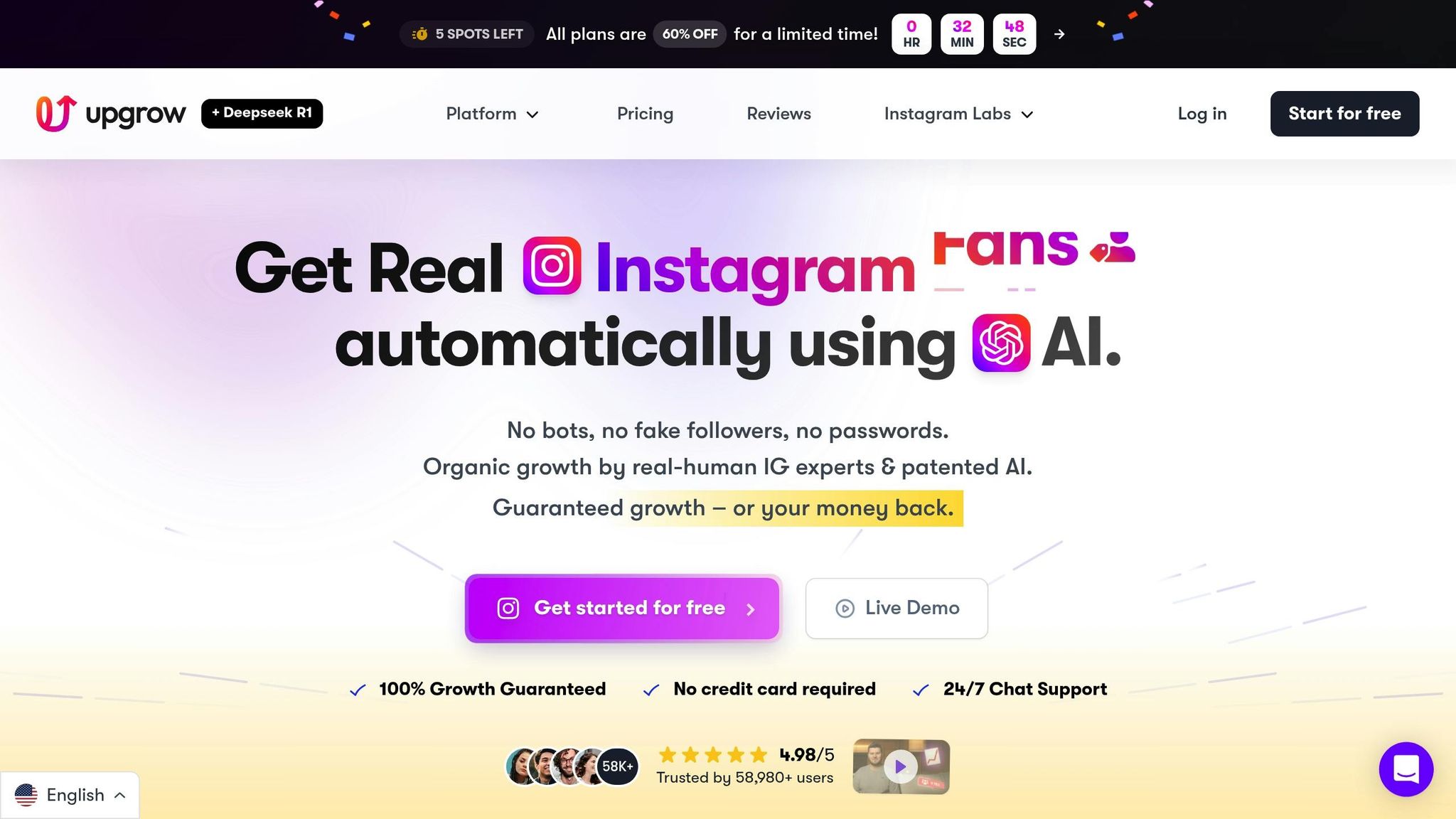
To address the challenges posed by Instagram's private dislike button, UpGrow offers a tailored solution that combines growth with safety. By leveraging intelligent targeting and monitoring, UpGrow ensures you attract the right audience while minimizing negative interactions.
The platform’s smart AI-targeting uses advanced filters - like location, age, gender, and language - to connect you with your ideal audience, reducing the chances of negative responses. Its analytics dashboard delivers instant insights into growth trends and engagement quality, helping you catch potential issues before they hurt your performance. The Boost™ tool optimizes posting times and content types based on engagement patterns, a key advantage if private dislikes start influencing rankings.
UpGrow also includes profile optimization features to ensure your account appears polished and trustworthy, reducing the likelihood of negative reactions. The platform's viral content library and ongoing monitoring keep your account compliant and effective. With plans starting at $39 per month and a growth guarantee, UpGrow offers an affordable way to achieve both safety and sustainable growth on Instagram.
Instagram’s move to introduce a private dislike button marks a major change in how brands approach content and manage their online communities. While the feature aims to encourage constructive interactions, it also brings new hurdles that brands need to address right away.
To stay ahead, start using sentiment analysis tools to spot negative trends early. This allows you to tweak your messaging and resolve issues before they spiral into larger problems.
AI moderation tools are no longer optional - they’re critical. With 59% of consumers ready to leave a brand after multiple bad experiences and 17% willing to walk away after just one, relying on manual monitoring alone is too risky. Combining real-time sentiment analysis with automated moderation can help you respond quickly and consistently while keeping your brand safe.
Shift your content strategy to focus on meaningful engagement rather than just chasing reach. This means refining your messaging, responding to feedback swiftly, and encouraging genuine interactions with your audience.
Instead of fearing private dislikes, treat them as valuable insights. By monitoring comments closely, tracking sentiment across platforms, and using AI tools, you can turn potential setbacks into opportunities to build stronger customer connections. These insights will be your best asset in adapting to this change.
The private dislike button is coming, and it’s time to prepare. By taking action now, you can maintain strong engagement and safeguard your brand reputation when the feature goes live.
To navigate the effects of Instagram's private dislike button, brands can focus on staying ahead by keeping a close eye on audience sentiment and engagement. Using AI-driven tools for sentiment analysis is a smart way to spot trends and catch shifts in how audiences feel before they escalate.
On top of that, building a welcoming and supportive community can make a big difference. Actively responding to feedback and interacting with followers shows that a brand values its audience, which can help minimize negative sentiment. By paying attention to audience reactions and fine-tuning content strategies as needed, brands can ensure they maintain a strong and positive presence on Instagram.
To protect your brand from the risks associated with Instagram's private dislike button, it's smart to stay ahead of potential issues. One way to do this is by leveraging sentiment analysis tools. These tools can help you keep an eye on feedback, spot emerging patterns of negativity, and address concerns before they spiral out of control.
Another key strategy is to cultivate a positive and interactive community. Make it a habit to engage with your audience regularly - respond to their questions, address their concerns openly, and promote meaningful conversations. By building genuine connections with your followers, you can create an environment where positivity thrives and negativity has less impact. Being responsive and approachable not only helps manage your brand's reputation but also reinforces trust with your audience.
AI-powered sentiment analysis enables brands to grasp audience emotions by examining comments and interactions as they happen. This real-time insight helps businesses spot negative feedback quickly, allowing them to tweak strategies and maintain a favorable brand image.
With these tools, businesses can fine-tune their messaging, craft content that better connects with their audience, and tackle potential concerns before they grow into bigger problems. The result? Improved engagement, stronger customer connections, and a safeguarded reputation.
Share this post


