
AI Hashtag Suggestions: Common Problems and Fixes
AI hashtag tools often produce broad, repetitive tags that hurt reach — fix them with precise inputs, varied mixes, and analytics.
AI hashtag tools often produce broad, repetitive tags that hurt reach — fix them with precise inputs, varied mixes, and analytics.
4.98 /5 - from 58k reviews
Trusted by 50,000+ creators — get real engagement delivered to your profile in minutes, not days.

AI hashtag generators can save you time, but they often fall short in delivering relevant, effective results. Common issues include overly broad or mismatched hashtags, repetitive suggestions, and a reliance on outdated data. These problems can hurt your reach and engagement, especially with Instagram’s evolving algorithm that prioritizes hashtag relevance and content alignment.
Key takeaways:
Solution highlights:
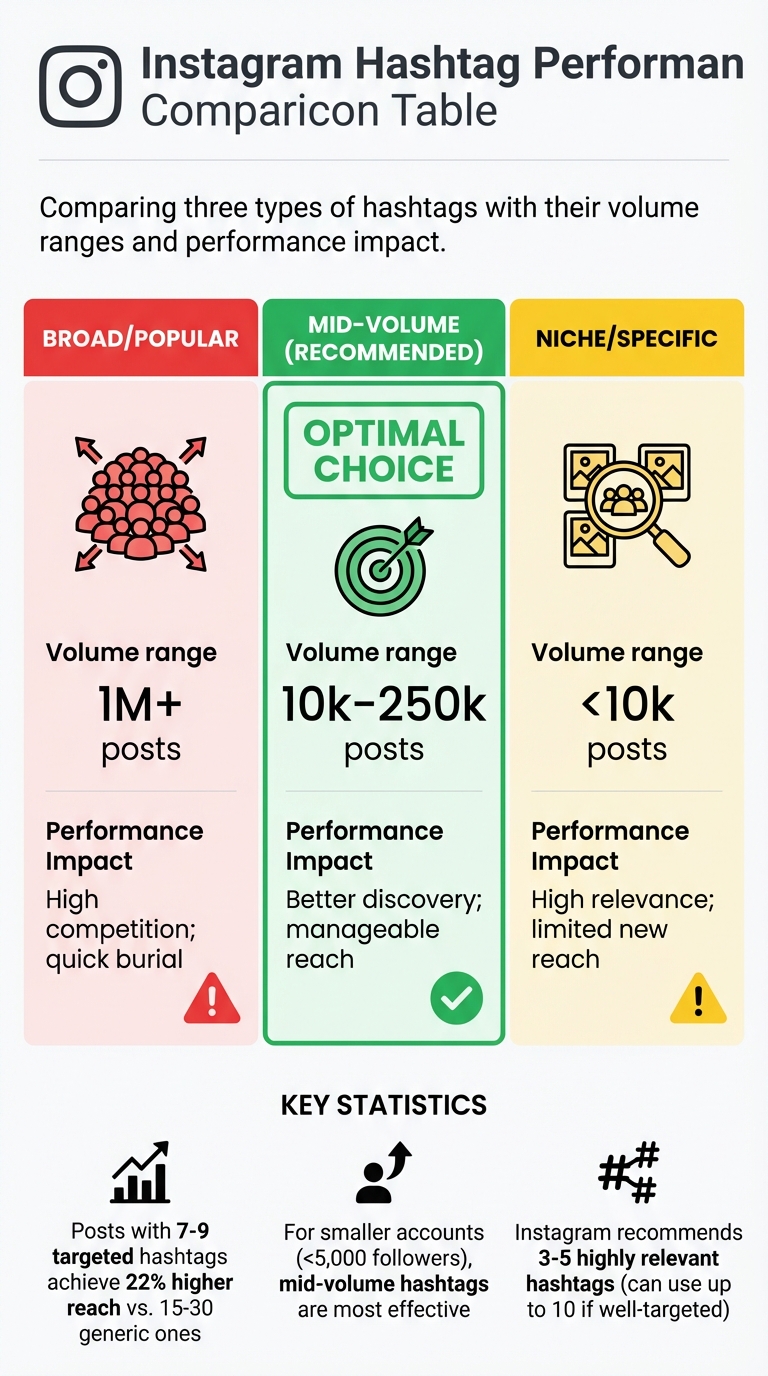
Instagram Hashtag Strategy Guide: Volume Ranges and Performance Impact
AI hashtag tools can be a handy way to streamline your Instagram strategy, but they’re far from perfect. Many users find that the hashtags these tools generate often miss the mark. Let’s break down the common issues and how they can derail your hashtag game.
AI tools often rely on historical social media data, which means they tend to suggest hashtags based on general popularity rather than what’s trending in your niche right now. For example, if you input something vague like "fashion post" or "travel photo", you might get generic hashtags like #love or #fashion. These tags may have millions of posts, making it nearly impossible for your content to stand out.
Instagram’s 2025 algorithm has stepped up its game, using advanced semantic analysis to ensure hashtags align with your account’s focus and your post’s content. Broad, irrelevant tags can hurt your reach. In fact, posts with 7–9 targeted hashtags have been shown to achieve 22% higher reach compared to those using 15–30 generic ones.
"The method to my hashtag madness lies in the range of specificity... it's important your hashtags aren't too vague."
- Drew McWhirter, Creative Marketing Lead, Anh and Chi
Another problem arises when AI tools fail to understand the context of your post. This often happens when inputs are unclear or when the tool relies on basic keyword matching instead of grasping the full meaning of your content. Without precise input - like specific keywords, media type, or target audience - the AI might suggest hashtags that misrepresent your post.
Instagram’s algorithm treats your bio, captions, and hashtags as a unified system. If these elements don’t align, your content risks being miscategorized. For example, accounts that update their bio keywords monthly to reflect their evolving themes see a 17% increase in Explore page impressions. Providing detailed, accurate information to the AI tool is key to avoiding mismatched suggestions.
While Instagram allows up to 30 hashtags per post, using all of them can sometimes hurt more than help. Overloading your post with hashtags - or using overly popular ones - can trigger spam detection and reduce your reach. Instagram itself recommends sticking to 3–5 highly relevant hashtags, though you can go up to 10 if they’re well-targeted.
Overly popular hashtags, with millions of posts, pose another challenge: your content gets buried almost instantly. For smaller accounts (under 5,000 followers), these high-competition tags are especially ineffective. Instead, focus on mid-volume hashtags (10,000 to 250,000 posts) that strike a balance between visibility and competition.
| Hashtag Type | Volume Range | Performance Impact |
|---|---|---|
| Broad/Popular | 1M+ posts | High competition; quick burial |
| Mid-Volume | 10k–250k | Better discovery; manageable reach |
| Niche/Specific | <10k posts | High relevance; limited new reach |
Even with hashtags, engagement isn’t guaranteed. If the tags are irrelevant or outdated, the typical 12% engagement boost disappears. Hashtags now need to show velocity - sudden increases in usage - to perform well. In 2025, using trending hashtags with fast-growing popularity can boost reach by up to 230% compared to sticking with generic, saturated ones. AI tools that rely on outdated data often miss these high-performing opportunities.
AI tools often recycle the same hashtag sets because they’re trained on historical data rather than pulling from real-time Instagram trends. Reusing identical hashtags not only signals automation but can also lower your reach by 36% compared to varying your selections. Outdated suggestions can further reduce visibility among non-followers by 22%.
"Using identical hashtag sets repeatedly signals automated behavior to Instagram's AI. Accounts that vary their hashtags post-to-post see 36% higher reach than those recycling 'safe' sets."
- Hanna Laas, Author
Instagram’s guidelines discourage repetitive content, and frequently reusing the same hashtags can lower your account’s quality score. This impacts your visibility on the Explore page and in hashtag search results. To avoid this, mix up your hashtags regularly and keep them aligned with current trends.
Here’s how you can refine AI-generated hashtag suggestions and improve your social media strategy.
The quality of hashtag suggestions often hinges on how specific your inputs are. Instead of entering something generic like "travel photo", try a more detailed description such as "sunset over Santorini with blue-domed churches." Be sure to include details like the format of your post (Reel, Story, or Carousel), location, and niche-relevant keywords. Adding descriptive adjectives can also make a difference. For instance, if your post is about fitness, write something like "30-minute home HIIT workout for beginners" instead of just "workout." Research has shown that using detailed inputs with AI tools can boost engagement by 23% compared to manually selected hashtags.
Never blindly accept the AI’s suggestions. Always take the time to review and filter the hashtags it generates. AI tools can sometimes recommend irrelevant, misleading, or even banned hashtags, which could hurt your reach. Double-check that each hashtag aligns with your content and avoid overly generic or spammy options. Smaller accounts should focus on niche hashtags rather than those with millions of posts, as niche tags often strike a better balance between visibility and competition. A quick search on Instagram can help you verify whether a hashtag fits your strategy.
A well-rounded hashtag strategy involves using a mix of different types of hashtags. Don’t rely solely on popular or niche tags - combine them to maximize visibility. For example, use 2–4 broad hashtags, 8–15 niche-specific ones, 2–5 community hashtags, and 1–3 branded tags. Although Instagram officially recommends 3–5 hashtags per post to avoid spam filters, rotating between 4–6 different hashtag sets across your posts can help prevent "hashtag fingerprinting", which could reduce your reach by up to 36%.
Tracking the performance of your hashtags is crucial for improving your strategy. Pay attention to which hashtags are driving impressions, engagement, and reach among non-followers. High-performing hashtags can contribute 20–40% of your total reach. Conduct a performance audit every 30 days to identify your top-performing hashtags and replace underperforming ones. Many successful brands use a mix of high-volume tags (over 1 million uses), medium-volume tags (100,000–1 million uses), and niche tags (under 100,000 uses) to optimize visibility across different hashtag pages.
AI tools often rely on historical data, which means they might miss out on current trends. To stay ahead, update your inputs with seasonal themes, viral topics, or trending events. Using hashtags that rank in the top 5% for velocity can boost your reach by up to 230%. Some advanced AI tools refresh their trending hashtag data every four hours, but if yours doesn’t, you can use social listening to track popular terms used by influencers in your niche. For example, leveraging viral hashtags from TikTok trends on Instagram can result in reach spikes of up to 250%.
AI hashtag generators are great for finding relevant tags, but pairing them with tools designed for targeted growth can take your engagement to the next level. UpGrow, an AI-powered Instagram growth service, offers features that work alongside your hashtag efforts to help you grow an engaged audience organically. Let’s break down how UpGrow enhances your hashtag strategy.
As of November 2025, only the first three hashtags on a feed post or reel impact its ranking. This shift means high-quality content plays a bigger role than ever. UpGrow’s viral content library is packed with proven formats, like tutorials and behind-the-scenes clips, that perform well even with limited hashtags. This allows you to pair your top three AI-generated hashtags with content designed to convert.
"The era of hashtag stuffing is over. It's time to prioritize SEO and keywords." – Hitesh, Author, Digital Marketing Expert
Creating great content is just part of the equation - tracking performance is just as important. UpGrow’s live dashboard provides real-time insights into your growth metrics, showing which hashtags are driving engagement and follower growth. Weekly performance reports break down engagement rates, follower increases, and content performance. This data-driven approach makes it easier to identify your best-performing tags and refine your hashtag strategy for better results.
Using the wrong hashtags or growth tactics can lead to spam penalties, shadowbans, or even account restrictions. UpGrow ensures your hashtag strategy stays safe by sticking to Instagram-compliant methods. Since 2016, the platform has helped users grow organically, earning a 4.98/5 rating from over 58,000 reviews. Hashtags are a core component of its AI-targeting system, allowing you to reach followers in your niche without risking penalties. With UpGrow, you can confidently experiment with AI-generated hashtags, knowing your account is secure.
AI hashtag generators can save you time on research, but they often churn out tags that are too broad, irrelevant, or repetitive - ultimately limiting your reach. The good news? These problems can be addressed. By providing precise inputs, rotating your hashtag sets weekly, and sticking to 5–10 carefully selected tags instead of spamming 30 generic ones, you’ll avoid triggering spam filters and connect with the right audience.
Instagram now evaluates hashtag relevance across your entire profile, considering how well your tags align with your bio, captions, and visual content. Creators who adopt this approach often experience noticeable growth.
"Hashtags support your content; they are not the primary reason for its success. If your content isn't performing, hashtags won't magically turn things around." – Yao Wang, Vizard.ai
To overcome these challenges, you need a combination of precise strategies and reliable tools. As discussed earlier, using targeted hashtag strategies can significantly expand your reach. Tools like UpGrow, with its real-time analytics and curated content library, take these efforts to the next level. By leveraging smart AI targeting and Instagram-approved growth methods, you can attract genuine followers who actively engage with your content. Testing new hashtag clusters and tracking their performance with data-driven tools like UpGrow can refine and elevate your strategy.
To get hashtags that truly resonate with your content, start by giving the AI tool a clear and detailed description of your post. Highlight its theme or niche - whether it’s about travel, fitness, art, or something else. This way, the tool can generate hashtags that are tailored to your content, rather than offering generic ones.
You can refine the suggestions even further by adding specific keywords tied to your brand, target audience, or location. At the same time, steer clear of overly broad tags like #love or #instagood - these can not only dilute your reach but might also risk shadow-banning. Instead, focus on hashtags that connect with the right audience. And don’t forget to regularly review and update your hashtag strategy to keep up with trends and maintain your visibility.
Whenever your content shifts in theme, style, or audience, make sure to run the generator again. AI tools are designed to adapt to trends, so refreshing your hashtags can help your posts stay discoverable and in tune with Instagram’s algorithm.
Using an overload of hashtags or leaning on extremely popular ones can hurt your Instagram game. Instagram might interpret this as hashtag stuffing, which could shrink your reach or even result in a shadowban. Plus, with overly popular hashtags, your content gets buried in a sea of posts, making it tough to get noticed.
Instead, aim for a balanced mix of niche, moderately popular, and branded hashtags that truly connect with your content and audience. This strategy not only boosts your chances of being discovered but also ensures you stay on Instagram's good side.
To keep your hashtag game strong, it’s important to regularly check how your hashtags are performing. Tools like Instagram Insights make this easy by providing data on metrics like reach, impressions, and engagement for each hashtag. Look for trends - are certain hashtags consistently driving engagement? Are others falling flat or even hurting your reach? Set clear benchmarks, such as aiming for a 10% engagement rate, and make it a habit to review your data weekly to spot underperformers.
For fresh ideas, consider using tools like UpGrow’s AI-powered hashtag generator. It can help you find trending or niche-specific hashtags that align with your content. Pair these new suggestions with your performance data to experiment with different combinations. Don’t let your hashtags get stale - rotate and update them regularly to stay relevant and avoid overuse. By keeping a close eye on your results and adjusting your approach, you’ll strengthen your connection with your audience and keep your content visible.


